
The Power of Setting
Updated: Nov 17, 2025

I love working with setting! For me, it’s an integral part of writing which can enrich your story with reflection, metaphor and symbolism. It can also be one of the most overlooked elements of fiction, which has traditionally been regarded as a temporal art (unfolding and evolving over time) rather than a spatial art, which emphasises narrative elements around space, arrangement and symbolic meaning.
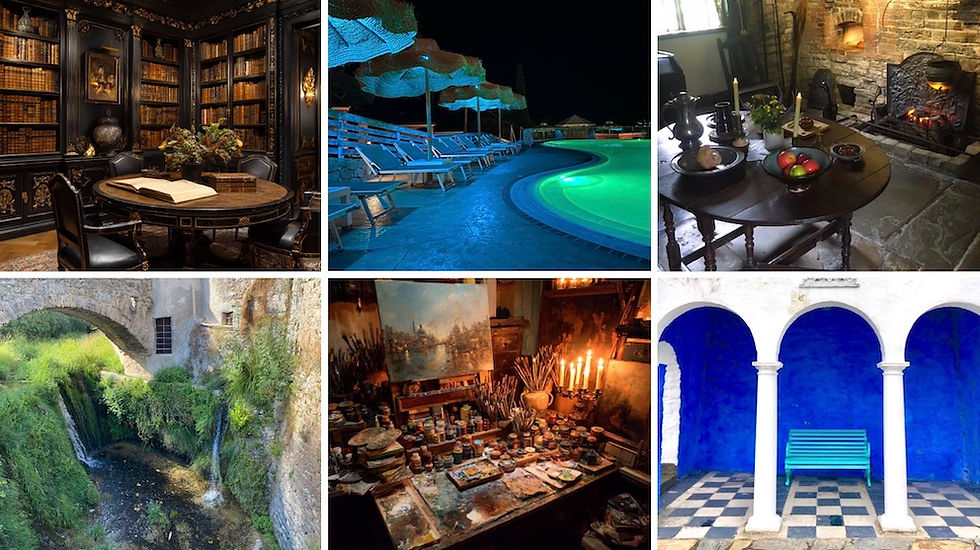
In a film, it’s easy to represent an entire space, like a secret library or an apothecary’s studio, just by showing it, but in a story, there isn’t the time or the room to cover every single detail. It would take ages to read and be incredibly boring! Over the years, I’ve read a few novels where the writer has used exhaustive lists over several pages to describe what the reader is seeing. One featured a banquet with an array of Christmas foods that filled an entire room to emphasise how the character had spent an enormous amount of effort to make the protagonist happy. But it had the opposite effect – the amount of detail was overwhelming and after a few lines, I began to skim read, then leapt ahead to the end of the list because I’d been jolted out of the story rather than being taken along the journey.
Too much detail ultimately slows down the pace of your story, threatens disengagement and plants a seed of doubt in the reader that they’re in the hands of a writer they can trust to create a believable world.
The most effective way to get around the problem of showing a space and evoking everything it contains is by describing a specific selection of objects instead. With specific details that suggest the whole picture, you allow the reader to fill in the rest with their imagination, like literary mind mapping.
Reading a novel is a uniquely intimate one-to-one connection that involves the writer sharing innermost thoughts and ideas that generate emotions in the reader. This connection has the potential to reach across the divide of language, culture and time, to express a view of the world (whether past, present or future) that is both unfamiliar and recognisable. Not everyone reading my novel The Bookfinder will be familiar with the worlds of art authentication, bookfinding, or cryptography, but they can believably imagine these worlds if given enough credible, as well as recognisable, details, with setting.
So, let’s row back a little and ask - what are the possible functions of setting and space? At its most basic, setting is a backdrop where characters act and interact so they’re not existing in a void. Otherwise, the reader will begin to create their own setting in their mind to replace the vacuum, which could be anything that will impact negatively on what the writer wants the reader to experience.
Setting can also help create mood to reflect/connect to the character's emotional and psychological state. But it’s good to avoid too much use of the ‘pathetic fallacy,’ where skies weep to indicate a character's distress or clouds droop to convey sadness. Giving inanimate objects human feelings is also something to be careful of because there’s a danger of sounding cliched or lazy. Such as a 'paper bag bustling importantly along the pavement' or a 'phone stubbornly not ringing.' Think of more subtle details, the unexpected…
The reader needs to be convinced of the plausibility of the setting, especially if you’re inventing a fantastical or magical world. So, concrete, convincing detail is essential for any setting to be believable and for the reader to accept as authentic.
Some story events and tensions can depend upon their setting. Not just adventure stories, war stories or action stories, but other genres where it might be as simple as sitting in a court room for a judgement or waiting at a fairground for a date to arrive. The details of a character's surroundings can be extremely effective in telling the reader about their circumstances – living conditions, day to day expectations, psychological states or past events.
When used as a metaphor, setting invites figurative as well as literal interpretation with details that suggest some aspect of the character or their situation. Like a toxic relationship evoked through the details of a home or the description of a landscape that suggests loneliness or desire. The way in which a particular character perceives a setting can also give the reader clues about their state of mind or can provide a stark contrast.
Some settings become like a character in its own right where the effect on the other characters and the story is profound. Think of Wuthering Heights (Emily Bronte), The Handmaid’s Tale (Margaret Attwood), Angela’s Ashes (Frank McCourt), 1984 (George Orwell), Slade House (David Mitchell), The Age of Innocence (Edith Wharton), The City and the City (China Mieville) and The Dead Zone (Stephen King.)
In The Art of the Novel, James Miller writes:
‘Place and setting represent more than just the external arena of your novel. They are not just a neutral picturesque backdrop… location is political, location is also symbolic and metaphoric. It stands for something greater than itself. If handled properly, the use of place in your novel will resonate and reflect the wider themes that your plot should explore.’
All the cities in my novel The Bookfinder - Prague, Rome, Venice, Bath - have an aura of fascination, serenity, beauty and mystery, which could be regarded as a sentimental reality, because like any city, there’s also turbulence, crime, poverty and banality. They’re also cities where tremendous cultural and historical changes have occurred that reflect a turbulent past being navigated for survival, which is what each of my characters face in the novel. Each city is evocative of these turbulent pasts, as well as being epicentres for significant cultural achievements, which aligns with the metaphor of cultural appropriation that affects the balance of power in my novel. So, each city location in The Bookfinder is both symbolic and metaphoric (and as an aside, I can’t wait for readers to enjoy it!)
If you’re pondering the element of setting for your story, a useful exercise is to consider your setting through Robert McKee’s structure in his fantastic book on writing, Story. He believes that a story setting is four dimensional:
PERIOD - A story’s place in time When is the story set? Past, present, future or a mixture of one or more?
DURATION - A story’s length through time What time span does the story cover? Seconds, minutes, hours, days, years or centuries?
LOCATION - A story’s place in space Where does it take place? Planet, country, area, environment, boundaries or limitations? LEVEL OF CONFLICT - The human dimension How does the setting affect and/or influence characters and plot, as well as internal and/or external conflicts?
There’s some exciting and useful exercises in my new online workshop about Genre & Setting that explores ways to develop your use of setting, depending upon your chosen genre. So, keep an eye out for it, and in the meantime, happy writing!


Comments